Rice and Beans: A Monument to Memory
One of the things I enjoy most about traveling is visiting museums. They tell you something about a place that you can't always learn from a guidebook. You begin to understand what a society chooses to remember, what its artists have wrestled with, and the questions that continue to shape its identity.
While I was in Brasília, Brazil, I spent an afternoon at the Centro Cultural Banco do Brasil (CCBB) visiting an exhibition titled Arte Subdesenvolvida (Underdeveloped Art). The exhibition explored how Brazilian artists responded to labor, inequality, industrialization, migration, and the social realities of twentieth-century Brazil. As I moved from gallery to gallery, I found myself thinking less about the differences between Brazil and the United States and more about the ways our histories often rhyme.
There were paintings of sugar cane workers, fishermen, and laborers that immediately caught my attention. There were beautiful prints that reminded me why I've found myself returning to printmaking in my own studio practice. But the work that followed me out of the museum wasn't a painting.
It was two bags sitting on a table.
The work is Anna Maria Maiolino's Monumento à Fome (Monument to Hunger). There are no figures. No elaborate construction. Just fifteen kilograms of rice and fifteen kilograms of black beans.
At first, I wondered why I couldn't stop looking at it.
Rice and beans aren't unusual. If you've spent any time in Brazil, you quickly realize they're part of everyday life. Walk into almost any restaurant around lunchtime and you'll see them on the plate. They aren't treated as something special. They're simply expected to be there.
The more I looked at the work, the more familiar it became.
It wasn't because I grew up eating Brazilian food. I didn't.
It was because rice and beans occupied the same place in family life that they did where I grew up. They were dependable. They fed a lot of people without costing much, and they showed up so often that nobody really stopped to think about where they came from. Standing in that gallery in Brasília, I realized I wasn't just looking at Brazilian food. I was looking at another chapter in the history of the African diaspora.
That thought stayed with me for the rest of the afternoon.
We spend a lot of time talking about paintings, music, literature, and photographs as carriers of culture. We preserve them in museums, archives, and libraries because we understand they tell us something about who we are. But standing in front of Maiolino's work, I found myself wondering why we don't think about food in the same way. A recipe travels. It crosses borders with families. It survives migration. It adapts to new climates, new ingredients, and new generations without losing its identity. Sometimes a family forgets the language their grandparents spoke, but they still cook the same meals. There may not be a better record of migration than the food people continue to prepare long after they've left home.
As someone who studied sociology before becoming a full-time artist, I've spent a lot of time thinking about culture and the ways it's passed from one generation to the next. We often imagine culture as something formal, books, music, religion, education, but much of it is learned without anyone ever sitting us down to teach it. It's in the way families gather around a table. It's in what gets served on holidays. It's in the meals that appear at funerals, birthdays, and Sunday afternoons. Those ordinary moments become so familiar that we stop recognizing them as history.
Looking at Maiolino's sculpture, I wasn't thinking only about Brazil anymore.
I was thinking about Mississippi.
I was thinking about my grandparents leaving the South for Chicago in 1939, carrying with them far more than their belongings. They carried habits, recipes, traditions, and ways of caring for one another that couldn't be packed into a suitcase. Like so many families during the Great Migration, they brought a culture with them. Some of it lived in stories. Some of it lived in church. Some of it lived in the kitchen.
The longer I stood there, the more I realized I wasn't responding to the materials themselves. I was responding to a memory. Hunger has been part of my life for as long as I can remember. In fact, my earliest memory is connected to it. That's a story for another day, but it explained why Anna Maria Maiolino's Monument to Hunger held me in that room. I wasn't trying to interpret the work. I was recognizing something that had been with me long before I ever walked into a museum.
That realization changed the piece for me. The title isn't Rice and Beans.
It's Monument to Hunger.
A monument is usually built to commemorate something a society has decided is important enough to remember. We build monuments to presidents, wars, inventors, explorers, and political leaders. Hunger has shaped countless lives, yet we rarely acknowledge it publicly. We don't build monuments to the families who quietly stretched a meal so everyone at the table could eat. We don't memorialize the parents who made sure their children were fed before serving themselves. Maiolino does.
She reminds us that hunger isn't simply the absence of food. It's part of the history of labor, migration, poverty, resilience, and survival. And perhaps that's why she chose rice and beans. They're not luxurious ingredients. They were never meant to be. They are the kind of foods that have sustained ordinary people for generations. They tell a story about making enough. About sharing. About endurance.
I walked into Arte Subdesenvolvida expecting to learn something about Brazilian art but I left thinking about my own family. I left thinking about the quiet ways culture survives and shows up when you least expect it.
Most of us think of history as something preserved in museums, written into books, or carved into stone. Anna Maria Maiolino reminded me that history also lives in far more ordinary places. It lives in the recipes families refuse to give up. It lives in the meals that outlast borders. It lives in the food that continues to nourish people long after the journey that first brought it there has been forgotten.
Sometimes a bowl of rice and beans tells us as much about a people as any painting hanging on a museum wall. And every now and then, it takes an artist to remind us to see it.
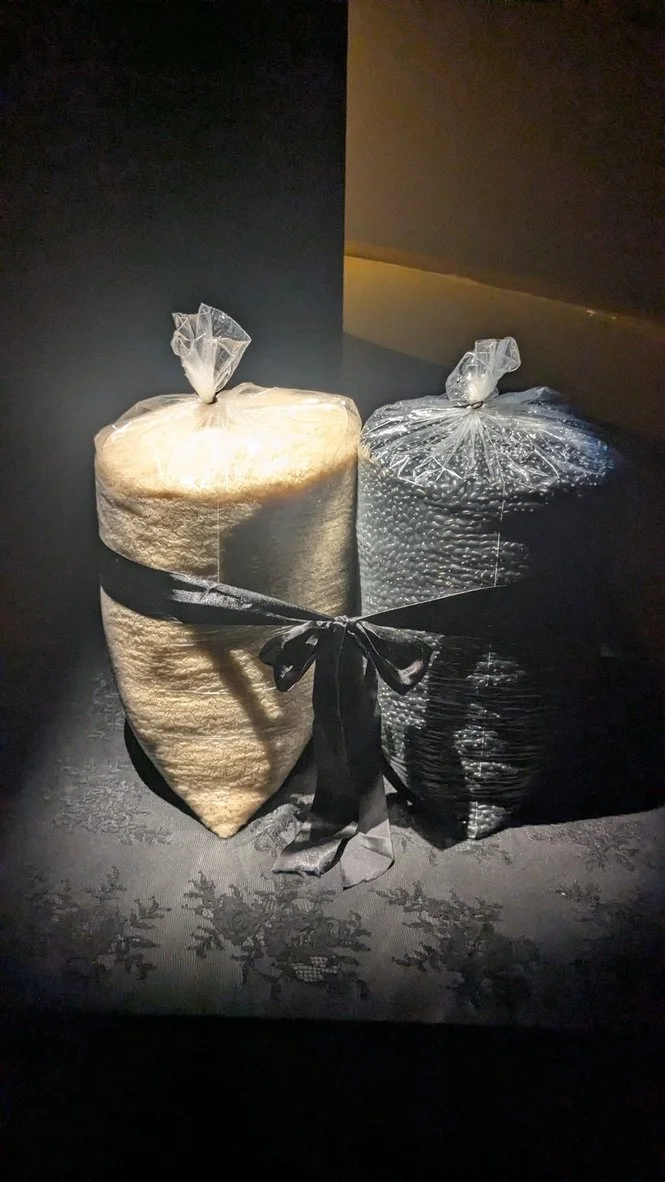
Photo by Y. Shabazz