Some things don’t pass. They return until they are understood.
There are things that don’t move forward the way we expect them to. They don’t disappear just because time has passed. They come back, sometimes quietly, sometimes without warning.
I’ve seen this in the studio, but I’ve also seen it in the classroom. In one of my workshops, a student told me something I’ve come to recognize as central to the work. He said he didn’t think he had much to tell. He had spent his time writing fiction, creating other worlds. It felt easier to build something imagined than to sit with what was his.
Then something shifted. Not all at once, and not in a way that announced itself, but over time he began to understand that he could bring his own life into the work. What he had lived—what he had carried—was enough. It didn’t have to be replaced by something else. He said it plainly: he realized that he had a story to tell (“I didn’t think I had anything to say at first… but then I realized my own story was enough.”).
That moment didn’t come from instruction alone. It came from returning to the work, again and again, until something opened. I’ve seen that happen more than once. It doesn’t arrive all at once. It builds through return.
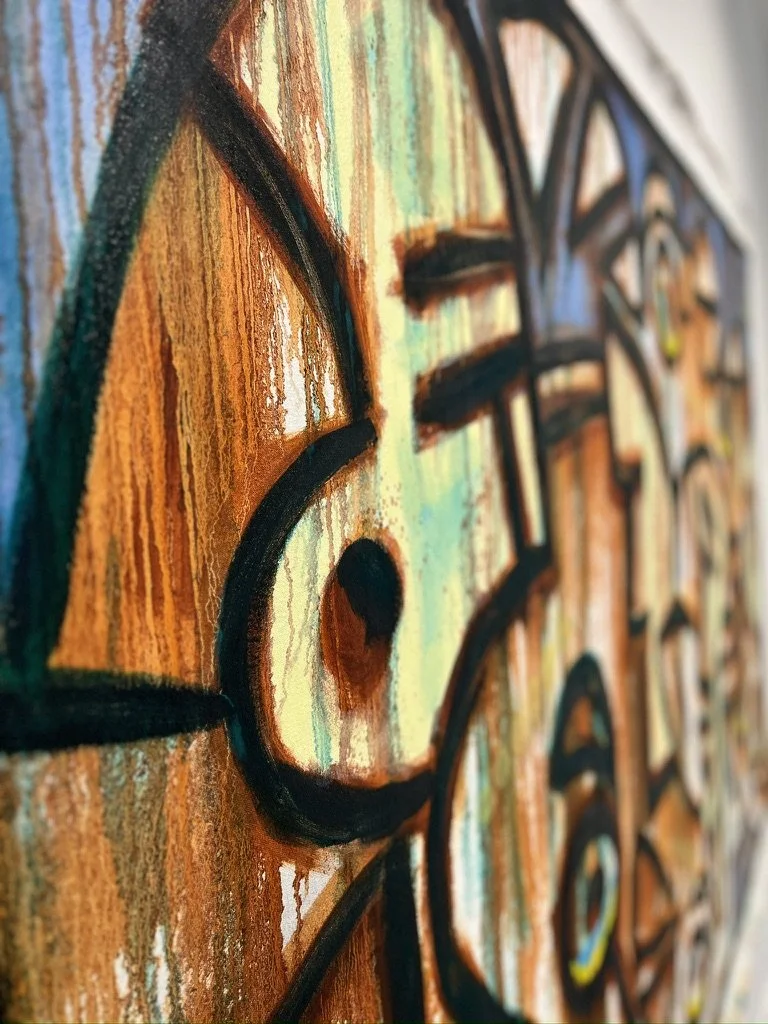
That is something I’ve come to understand, whether in teaching or in the studio. What sits beneath the surface doesn’t go away just because it’s covered. It remains active. In my own work, I return to the same surface over time. I make a change, step away, and come back to it. Sometimes I think something is finished, only to realize later that I haven’t fully seen it yet. Going back isn’t a failure. It’s part of the process.
The surface holds time. Each layer carries a record of attention—what was done, what was reconsidered, what was left unresolved. The same is true in how people develop. What looks like resistance is often something unfinished, something that hasn’t been worked through yet. It doesn’t pass just because time moves forward. It returns.
In that same conversation, the student spoke about hope. Not in a dramatic way, but in a quiet recognition that something was possible. That shift didn’t come from being told what to do. It came from being in a space where he could stay with something long enough to see it differently.
That is the work. Not forcing resolution or rushing toward completion, but staying with something long enough for it to take shape. The question isn’t how to avoid the return. It’s whether you’re willing to meet it.