The Difference Between Looking and Seeing: On art, perception, and the slow development of awareness
Most people spend their lives looking at the world without ever truly seeing it.
I do not mean that as an insult. I think it is largely the result of speed. Modern life trains people to move quickly through experience. We scan. We categorize. We react. We consume enormous amounts of information and imagery every day, but very little of it settles deeply enough for sustained observation to occur.
If you know me personally, or have had conversations with me about my teaching inside prisons and penal institutions, or even about my own experience with incarceration as a young man, then you already know that confinement changes a person’s relationship with attention. Restriction forces people to slow down. And when movement slows down long enough, observation often deepens.
In many ways, survival in those environments depends on learning how to manage the internal environment psychologically. You learn how to sit with yourself differently. You become more aware of thought patterns, emotional shifts, tension, silence, and atmosphere. Over time, many people develop an intense relationship with observation because attention itself becomes connected to stability, awareness, and survival.
Looking is fast.
Seeing requires time.
That distinction became clearer to me through painting and teaching art. One of the first things many beginning students discover is that they are not actually drawing what they see. They are drawing what they think they see. There is a difference.
A student sits in front of a face and immediately begins reproducing symbols: an eye, a nose, a mouth, hair. But real observation is slower and more complicated than that. The artist eventually realizes the eye is not simply an eye. It is shape, shadow, reflected light, temperature, proportion, rhythm, tension, and relationship to everything surrounding it.
The same thing happens with color.
There were early periods in my development as a painter when I realized I was physically looking at the world differently. I would look at the sky and begin noticing that it was not one blue. It contained ultramarine, cobalt, reflected grays, warmth near the horizon, and subtle shifts in atmosphere. I started seeing warm reds beside cooler reds. I noticed greens and blues beneath skin tones, both in lighter and darker complexions. I became aware of reflected color, edge relationships, negative space, gesture, rhythm, and the underpainting that nature itself seems to carry beneath the visible surface.
The world had not changed.
My perception had.
That may be one of the most important things art education offers people. At its best, it retrains perception. It slows observation down long enough for understanding to deepen.
Looking is physical.
Seeing denotes understanding.
The eyes perform the act of looking, but the mind processes meaning. We can spend our entire lives looking at the sky without truly seeing it because seeing requires more than eyesight. It requires processing, reflection, patience, and awareness.
I think this applies far beyond art.
Human beings often move through relationships the same way beginning students move through drawing. We substitute assumptions for observation. We decide who people are too quickly. We interpret through stereotype, inherited narratives, emotional projection, fear, or social conditioning rather than direct awareness.
In many ways, society rewards speed more than depth. Fast opinions. Fast reactions. Fast judgments. But perception does not fully develop at high speed. Some things only reveal themselves through sustained attention.
That includes people.
One of the most powerful moments I experienced teaching art happened in a prison classroom. I had a student whose first language was Spanish. During one class he became completely absorbed in mixing colors on his palette. He was not focused on the assignment itself anymore. He was exploring. Experimenting. Mixing different variations of red and blue together and watching what happened.
I could tell he was fully locked into the process, so I left him alone and let him work.
At one point I leaned over and quietly told him, “Add a little white and see what happens.”
Near the end of class he suddenly yelled out loud, “Purple!”
He was excited like a child discovering something for the first time. “Red and blue make purple!” he kept saying with this incredible sense of wonder and excitement. It was as if an entirely new world had opened up in front of him. After that day he became deeply attentive to color relationships in all of his paintings.
That moment stayed with me because it reminded me that seeing is not merely visual. It is experiential. Psychological. Emotional. Sometimes even spiritual. There is a kind of joy that appears when a person suddenly realizes the world contains more depth than they previously understood.
Patience plays a major role in that process.
You have to sit with things long enough to truly see them. Not only visually, but emotionally as well. Sometimes you have to sit with a moment long enough to understand the feeling it carries beneath the surface.
I learned something similar very young while spending time in the Art Institute of Chicago. I learned to enjoy artwork before I learned how to make artwork. I would sit with paintings for long periods of time and notice how differently people moved through galleries. Some rushed from one painting to the next almost mechanically, barely stopping long enough for observation to settle in. Others slowed down. They studied. Returned. Sat quietly with the work.
Even as a kid, I sensed there was a difference between briefly looking at art and allowing yourself to experience it fully.
I think technology and social media have complicated that relationship with perception even further. People consume more imagery now than any generation in history, but much of it is processed extremely quickly. Visual culture has become hyper-saturated, hyper-real, sharpened, filtered, intensified. Colors are pushed beyond their natural state. Saturation is increased. Contrast becomes exaggerated. Everything becomes brighter, cleaner, more vivid than reality itself.
Over time, I think this changes perception psychologically.
People become conditioned by artificial intensity. They begin expecting the world itself to function like edited imagery. And when they encounter subtlety, atmosphere, brushwork, softness, or slower forms of visual language, they sometimes struggle to read it.
Painters notice brushstrokes.
Artists notice edge relationships.
They notice silence in imagery.
They notice tension, atmosphere, rhythm, gesture, posture, and emotional weight carried inside visual form.
Most people are moving too quickly to notice those things consciously.
That is why I believe art changes more than technical ability. Over time, it changes the person observing.
You begin noticing contradiction more clearly. You become more attentive to emotional atmosphere, silence, posture, and the difference between performance and sincerity. You begin seeing yourself differently as well.
And that can be life changing.
When a person begins seeing themselves clearly, self-discipline often improves. Communication improves. Awareness deepens. They begin understanding themselves in relationship to others the same way colors function in relationship to one another within a painting. Certain combinations create tension. Others create harmony. Some intensify each other. Some mute each other completely.
Human beings move through relationships similarly.
I think children naturally understand some of this better than adults. Children explore the world instinctively. In Islam, there is a concept called fitra, the natural disposition human beings are born with before conditioning reshapes perception. I think children often still possess parts of that natural seeing. A child can spend long periods of time fascinated by something simple: a stick dragging through dirt, the sound of rocks moving together, the lines created in sand, reflected light moving across water.
They are completely absorbed in discovery.
Adults often lose that.
We stop exploring. Stop observing deeply. Stop sitting with things long enough for understanding to emerge.
But reality still reveals itself through sustained attention.
That is something painting taught me repeatedly. Returning to an image, a surface, a memory, or even a single color relationship over and over again changes what becomes visible. Repetition sharpens perception. Sustained observation deepens understanding.
And maybe that is what seeing really is.
Not simply looking harder but remaining present long enough for reality to reveal more of itself.
“The world speaks quietly through light, posture, silence, color, and even the spaces between words. Most people look long enough to recognize something familiar. Very few remain present long enough to truly understand what they are seeing.”
Ya’qub Shabazz
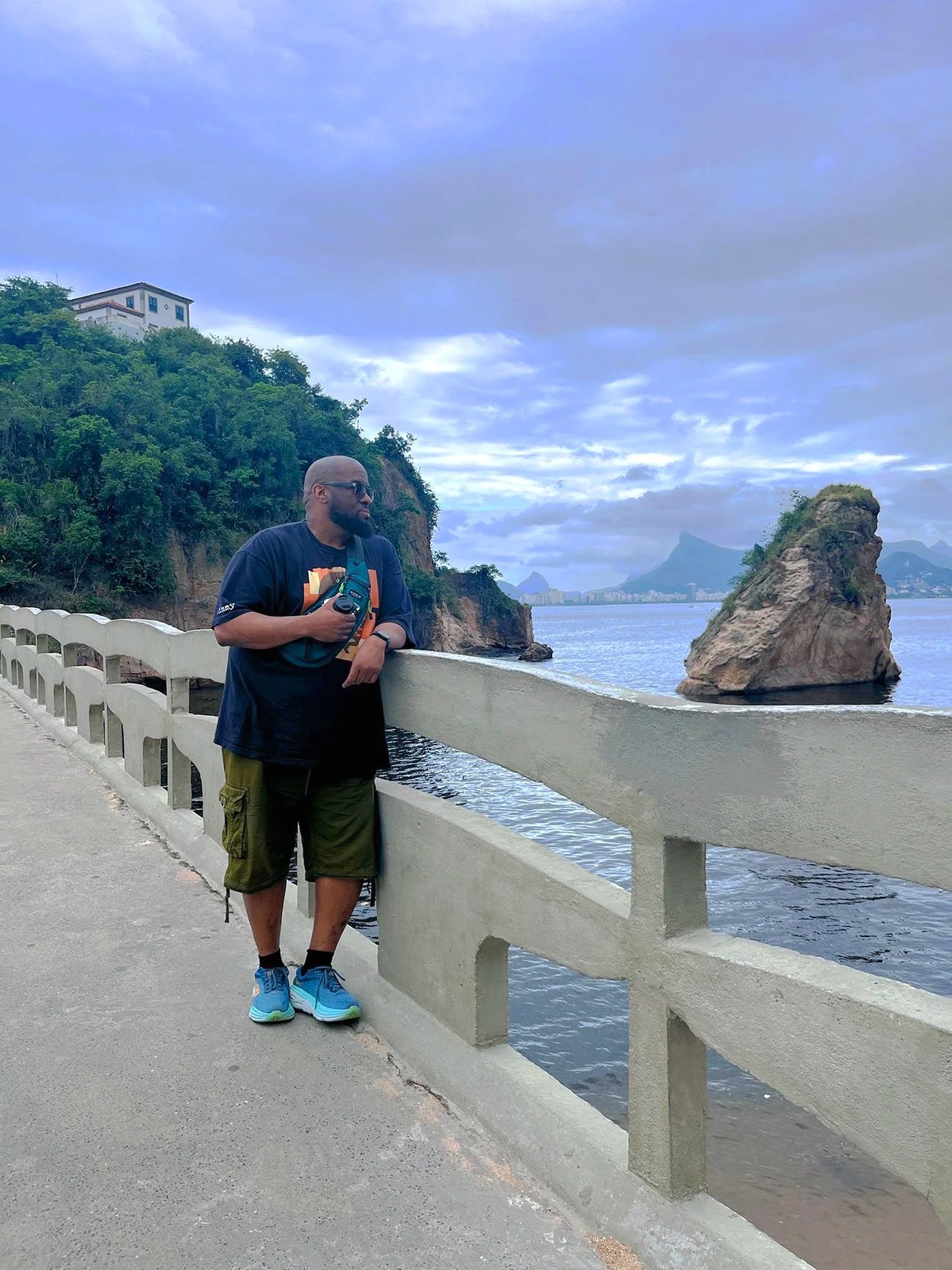
Me in Rio de Janerio, 5//2025